
Note
Go to the end to download the full example code.
Subpixel interpolation errors#
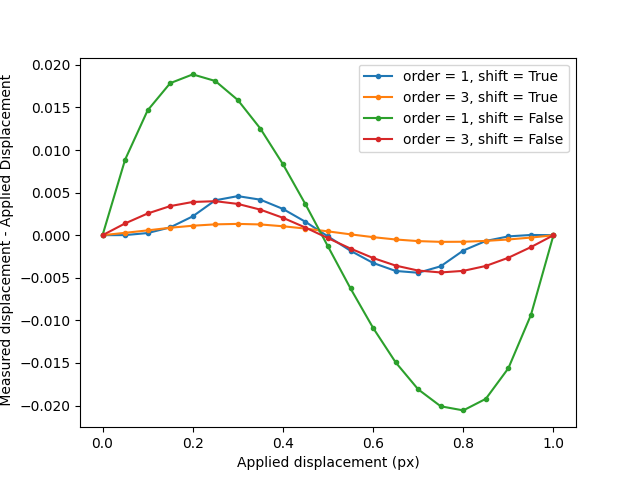
Image correlation can easily be more accurate than pixel in displacements. However for measuring very small displacements, systematic interpolation errors can appear that have a small bias towards integer or 0.5 pixel displacements.
This example illustrates and studies this systematic error.
This error is typically reduced using higher order interpolation (order 3 instead of order 1).
We will also show an elegant mitigation from [Wantz2025] called “Shift-DVC” that we have implemented in 2D and 3D.
We will apply synthetic displacements to an existing pattern, and it is essential to use a different interpolator than what will be used for the correlation, for this we will Fourier shifts.
Import modules#
import numpy
import matplotlib.pyplot as plt
import spam.deformation
import spam.DIC
import spam.datasets
Define function to shift images in Fourier space#
def fourier_shift(im, shift_z=0, shift_y=0, shift_x=0):
    nz, ny, nx = im.shape

    # FFT freq
    kz = numpy.fft.fftfreq(nz)
    ky = numpy.fft.fftfreq(ny)
    kx = numpy.fft.fftfreq(nx)

    # put them in the freq grid
    kz, ky, kx = numpy.meshgrid(kz, ky, kx, indexing="ij")

    # phase shift
    phase = numpy.exp(-2j * numpy.pi * (shift_z * kz + shift_y * ky + shift_x * kx))

    # returb shifted
    return numpy.real(numpy.fft.ifftn(numpy.fft.fftn(im) * phase))
Here we will load the data and synthetically apply subpixel displacements from [0, 1] px in N steps
# Load data
im = spam.datasets.loadSnow()[0:50, 0:50, 0:50]

N = 20
steps = numpy.linspace(0, 1, N + 1)

# N x im series of displaced images
ims = numpy.zeros((len(steps), *im.shape))

for n, step in enumerate(steps):
    ims[n] = fourier_shift(im, shift_x=step)
Here we will do image correlations, varying the shift option and the interpolation order
for shift in [True, False]:
    for order in [1, 3]:
        displacements = numpy.zeros((N + 1, 3))
        for i in range(N + 1):
            reg = spam.DIC.register(
                ims[0],
                ims[i],
                # margin=4,
                interpolationOrder=order,
                # deltaPhiMin=0.001,
                shift=shift,
                # PhiInit = spam.deformation.computePhi({'t': [0.,0.,-1.]})
                # verbose=True
            )
            displacements[i] = reg["Phi"][0:3, -1]
        print(displacements[:, 2])
        plt.plot(steps, displacements[:, 2] - steps, ".-", label=f"{order = }, {shift = }")
plt.xlabel("Applied displacement (px)")
plt.ylabel("Error (px)\n Measured displacement - Applied Displacement")
plt.legend()
plt.show()
[0.    0.05  0.1   0.151 0.202 0.254 0.305 0.354 0.403 0.452 0.5   0.548
 0.597 0.646 0.696 0.746 0.798 0.849 0.9   0.95  1.   ]
[0.    0.05  0.101 0.151 0.201 0.251 0.301 0.351 0.401 0.451 0.5   0.55
 0.6   0.649 0.699 0.749 0.799 0.849 0.899 0.95  1.   ]
[0.    0.059 0.115 0.168 0.219 0.268 0.316 0.363 0.408 0.454 0.499 0.544
 0.589 0.635 0.682 0.73  0.779 0.831 0.884 0.941 1.   ]
[0.    0.051 0.103 0.153 0.204 0.254 0.304 0.353 0.402 0.451 0.5   0.548
 0.597 0.646 0.696 0.746 0.796 0.846 0.897 0.949 1.   ]
Total running time of the script: (0 minutes 24.913 seconds)